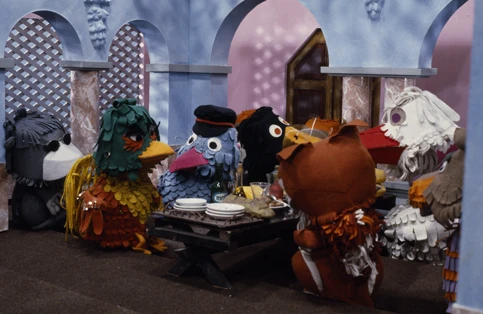
Motormouth
Saturday morning magazine show from TVS, 1988–1992.
Motormouth was a Saturday morning children's show made by TVS for the ITV network. It ran for four series, from 3 September 1988 to 4 April 1992. Like many main Saturday morning series of the time, each series typically ran from autumn to spring.
The show was created after the decision to cancel *No. 73*, which had occupied the same slot until early 1988. The final series of *No. 73* had been revamped as *7T3*, using a partly outdoor set, but this proved expensive and difficult to produce. The switch to a fully studio-based show led to *Motormouth*, produced at the same Maidstone Studios and sharing much of the production team and several presenters. Unlike *No. 73*, which had an ongoing narrative, *Motormouth* adopted a straightforward magazine format.
The first series’ studio set featured large inflatable elements, including a giant motorised mouth that gave the show its name. For the second series, sometimes billed as *Motormouth II* or *Motormouth 2*, new graphics and set pieces based on cogs and sprockets were introduced, and the giant mouth was used less. The third series, briefly called *All New Motormouth*, had a mostly white set, new graphics, and a remixed theme tune. The giant mouth and all other inflatables were removed, and a diner-style set, sometimes called the Motormouth Cafe, was added, where guests and audience members sat at tables. This format and styling continued largely unchanged into the fourth series.
The first series had five main presenters: Neil Buchanan and Andrea Arnold (both from *No. 73*), plus Caroline Hanson, Tony Gregory, and Julian Ballantyne. For the second series, Andrea Arnold stopped being a main presenter and instead filed location reports from around the world. Hanson and Ballantyne left, replaced by Gaby Roslin and Steve Johnson. Buchanan and Gregory stayed. Generally, Buchanan, Gregory, and Roslin handled studio segments, while Johnson hosted the gameshow inserts *It's Torture*, *Gunge 'em in the Dungeon*, and *Mouse Trap* (based on the board game). By the third series, Arnold had left entirely, and Gregory departed, replaced by former Children’s BBC presenter Andy Crane. Crane, Buchanan, Roslin, and Johnson remained until the show ended.
The first series included *Spin-off*, a soap opera parody set behind the scenes. Its cast featured Richard Waites, who had appeared in the final series of *No. 73/7T3*. *Spin-
- field
- Children's television
- network
- ITV
- first_aired
- 3 September 1988
- last_aired
- 4 April 1992
- number_of_series
- 4
- production_company
- TVS
- studio
- The Maidstone Studios
Lore & Background
Motormouth was launched after the decision to axe No. 73, which had been revamped as 7T3 with a partially exterior set that proved expensive and difficult to produce. The new show returned to a fully studio-based set-up, retaining many of the production team and several presenters from its predecessor. The first series' set featured giant inflatable elements, including a giant motorised mouth that gave the show its name. The second series introduced new graphics and set elements based on cogs and sprockets, and the use of the giant mouth declined. The third series, briefly billed as All New Motormouth, had a predominantly white set with the giant mouth and all other inflatables removed, and introduced a diner-style set called 'The Motormouth Cafe' where guests and audience members sat at tables. This format and styling largely continued into the fourth series.
Reader's Guide
Motormouth was a significant Saturday morning children's programme on ITV, running for four series from 1988 to 1992. It was produced by TVS at The Maidstone Studios, which later hosted other Saturday morning shows such as Ministry of Mayhem and Basil's Swap Shop. The show featured a rotating lineup of presenters, including Neil Buchanan, who fronted all four series, and launched or furthered the careers of several television personalities. Gaby Roslin went on to co-host The Big Breakfast on Channel 4, Andy Crane moved to What's Up Doc? and Bad Influence!, and Steve Johnson hosted Terror Towers. Andrea Arnold transitioned to film-making, winning an Oscar in 2004 and a BAFTA in 2007. The programme included fictional elements such as the soap opera parody Spin-off in its first series and a comedy-drama storyline woven into the main programme in its fourth series. It also featured imported cartoons including She-Ra: Princess of Power, Samurai Pizza Cats, The Real Ghostbusters, and Scooby-Doo. Motormouth was cancelled after TVS lost its ITV franchise, and was replaced by What's Up Doc?, produced under an agreement between TVS, STV, and Warner Bros. Most of the series has been wiped from the archives, with only some editions from series 3 and 4 surviving as off-air recordings.
Did You Know?
- The show's name came from a giant motorised mouth on the first series' set.
- The third series introduced a diner-style set called 'The Motormouth Cafe'.
- Most of the series has been wiped from the archives; only off-air recordings of some editions from series 3 and 4 are known to exist.
- The final edition of the fourth series featured a wedding storyline between characters Juliet Nichols and Max Church.
Frequently Asked Questions
What was Motormouth?
Motormouth was a Saturday morning magazine show aimed at children, produced by TVS and broadcast on ITV. It ran for four seasons between 1988 and 1992, filling the same weekend slot that had previously been held by No. 73.
Why was Motormouth created?
The show came into existence after ITV chose to cancel No. 73, whose final revamped series 7T3 had grown too expensive and logistically tricky to film partly outdoors. Producers therefore shifted to a fully studio-based format, which became Motormouth.
How long did Motormouth run and when did it air?
The programme first aired on 3 September 1988 and concluded on 4 April 1992, spanning four series in total. Each season followed the standard autumn-to-spring schedule typical of Saturday morning children's shows at the time.
Where was Motormouth filmed?
All production took place at Maidstone Studios, the very same facility that had hosted its predecessor No. 73. TVS handled the entire production for the ITV network.
What kind of show was Motormouth?
It was a studio-based children's magazine show designed for the ITV Saturday morning slot. Rather than being a scripted drama or animation, it followed the magazine format common to weekend kids' programming of the late 1980s and early 1990s.
More in part-1
Spotted an error? Know more?
This is a living reference — every entry is fact-audited, and reader corrections feed straight into our audit queue. Suggest an edit · See this site's audit record