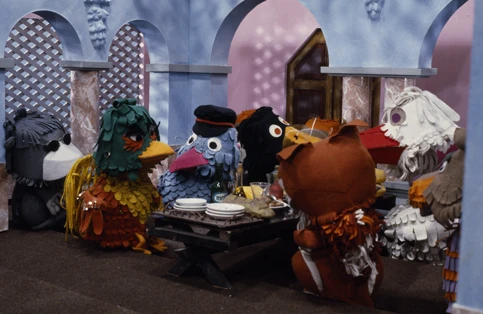
Parallel 9
BBC Saturday morning series with frequent cast and format changes.
Parallel 9 is a British children's television series that aired on BBC1 from 25 April 1992 to 17 September 1994. It was the first BBC Saturday morning children's series produced by an independent production company, Roach & Partners, rather than the BBC's in-house unit. The show is notable for its frequent cast and situation changes while retaining the same branding throughout.
- field
- Children's television
- nationality
- British
- known_for
- First BBC Saturday morning series by an independent producer; frequent cast and format changes
- network
- BBC1
- production_company
- Roach & Partners
- filmed_at
- Pinewood Studios
Lore & Background
The first series centered on Mercator, an alien 'Time Baron' with long eyebrows (played by Roddy Maude-Roxby), banished to Parallel 9 for summoning an Earth girl named Calendular in his quest for knowledge. He could awaken only two hours each Saturday, from 9am to 11am, and could 'beam up' Earth guests. Other banished aliens—Steyl, Skyn, and Thynkso—plotted escape. Celebrity guests included Kylie Minogue, Dannii Minogue, Right Said Fred, and Frank Bruno.
Series 2 introduced a younger, manic Mercator (Christopher Wild), a brighter set, and new characters Zee, Dr. Kovan, and Brian the Dinosaur (created by David Claridge). The Tope cubicle changed from a dimensional prison to the space station's power source. An Earth-based presenter in a static caravan provided a 'link' for guest transportation, first Richard Norton, then Lucinda Cowden.
Series 3 recast Mercator as a buttoned-down commander (Richard Waites). Zee was replaced by Flynn (Kate Lonergan). Dr. Kovan and Brian remained, joined by a younger dinosaur Derek. The Earth base concept continued with Paul Hendy joining Cowden.
Reader's Guide
Parallel 9 holds a unique place in British children's television history as the first BBC Saturday morning series produced by an independent company, marking a shift in production practices. Its most distinctive feature was the radical overhaul of cast and setting between series while keeping the same title and branding—an unusual approach that allowed the show to reinvent itself. The series is also remembered for its varied celebrity guests and the use of a static caravan as an Earth-based link. Though it ran only two and a half years, its format changes and independent production status make it a notable example of early 1990s children's programming experimentation.
Did You Know?
- Parallel 9 was the first BBC Saturday morning children's series produced by an independent production company, Roach & Partners.
- The character Mercator was played by three different actors across the three series: Roddy Maude-Roxby, Christopher Wild, and Richard Waites.
- Brian the Dinosaur was created by David Claridge, who also created Roland Rat.
- The Tope cubicle changed function between series 1 and 2, from a dimensional prison to the space station's power source.
Frequently Asked Questions
What is Parallel 9?
Parallel 9 is a British children's television programme that occupied BBC1's Saturday morning slot from April 1992 to September 1994. It was filmed at Pinewood Studios and produced by the independent company Roach & Partners.
Who produced Parallel 9 and why does that matter?
The series was made by Roach & Partners, an outside production company rather than the BBC's own in-house unit. That made it the first BBC Saturday morning children's show to be commissioned from an independent producer, marking a shift in how the network handled kids' programming.
When did Parallel 9 first air and when did it end?
The show premiered on 25 April 1992 on BBC1 and wrapped up its final episode on 17 September 1994. In total it ran for roughly two and a half years in the network's Saturday morning block.
What was unusual about Parallel 9's format over its run?
The series cycled through several different casts and on-screen situations across its broadcast life. Despite those changes, it kept the same 'Parallel 9' branding on screen throughout, which fans often point to as both its quirk and its identity.
Where was Parallel 9 filmed?
All of the series' production work took place at Pinewood Studios. No other filming locations are credited in the show's production records.
More in part-1
Spotted an error? Know more?
This is a living reference — every entry is fact-audited, and reader corrections feed straight into our audit queue. Suggest an edit · See this site's audit record